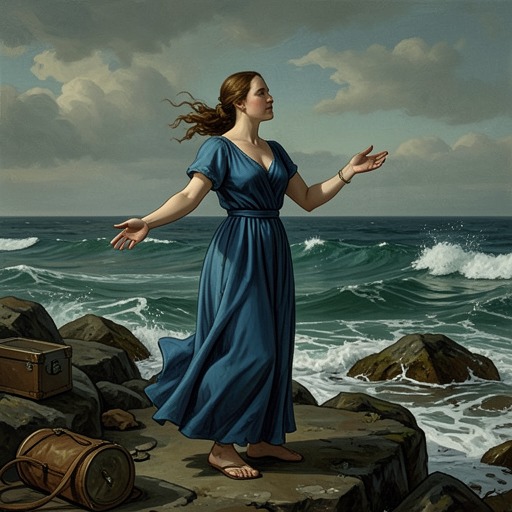
Marie-Josèphe and the sea woman establish communication
The Moon and the SunMarie-Josèphe de la Croix and the Sea Woman establish communication across a divide that spoken words cannot bridge: the Sea Woman’s songs convey images, sensations, and relationships, while Marie-Josèphe learns to listen, interpret, and answer in kind. Their exchange changes the captive from an object of spectacle into a person whose memories and loneliness can be recognized, even though the two have not yet developed a fluent shared language.
A language of images and associations
Marie-Josèphe first approaches the possibility of communication while sitting on the rim of the Fountain. She imagines that, if the situation were a dream, neither she nor the Sea Woman would be imprisoned. The Sea Woman’s song then summons an image of the male sea person whose body Yves de la Croix is dissecting: he swims around the ceiling of the tent, an image that remains vivid even after Marie-Josèphe closes her eyes. The scene presents song as a means of making the absent and dead perceptible, but the vision is formed in Marie-Josèphe’s mind by the Sea Woman’s singing; it is not a physical return of the dissected body.
Marie-Josèphe tests whether the Sea Woman understands her and asks whether she speaks in words. The Sea Woman answers with a single word, “Fishhh,” and then sings. A tiny fish appears in Marie-Josèphe’s vision, its outline roughened by the rasp in the Sea Woman’s voice. The song does not merely name the fish: it evokes the creature, its surroundings, the sound of its swimming, and the taste of its flesh. The narrative describes sea people’s communication as a language of images and connections rather than a sequence of verbal labels. Meaning arrives through a mesh of qualities and relations, not through a direct translation into human speech.
The difference between the two listeners remains important. Marie-Josèphe hums the fish’s melody in response, but the image she sends back is indistinct and disappears. She recognizes that her own song may sound like a blur to the Sea Woman and promises to do better. Her question about the Sea Woman’s name produces a complicated melody describing the singer herself, including hints of joy, brashness, and youthful wisdom. This is an answer, but not a conventional name that Marie-Josèphe can repeat or write down. Her response, that the song is beautiful and perfect, registers the force of what she has received without pretending that the exchange is already complete.
Learning to listen and answer
The Sea Woman swims toward Marie-Josèphe and rests her elbows on the lowest step, gazing at her as whispered song forms shapes and scenes. Marie-Josèphe runs to the laboratory for scraps of paper and charcoal, then returns to sketch what the songs show her. She records neither words nor musical notes, but rough pictures. The sketches sometimes blur when tears fall on the paper, while the scenes remain clear in her hearing. Her method is provisional: she is not producing a dictionary or a reliable transcription, but making a visual record of a meaning she can perceive and has not yet learned to reproduce accurately.
The pictures also make the gap between the Sea Woman’s life and her present surroundings visible. In song, she swims alone through a fountain dimmed by filth and algae, its bottom littered with coins and rubbish. The music transforms the same enclosed water into a sapphire sea; the debris becomes white sand and living shells, and iridescent fish pass through it, changing together from blue to silver. This is not simply a description of a beautiful underwater world. The song sets the Sea Woman’s remembered, living environment against the dirty, artificial pool where she is held. The contrast gives Marie-Josèphe a way to apprehend what captivity has taken from her interlocutor.
A life disclosed through song
In a later exchange, a barrel bumps repeatedly against the platform, interrupting Marie-Josèphe as water splashes onto her shoes. She kneels and puts her hands into the water. The Sea Woman stops battering the barrel and swims past Marie-Josèphe’s fingers. With one brief burst of song, she sketches the breadth of her life: catching food, swimming among bright coral reefs in tropical seas, and capering between inverted iceberg mountains in northern waters. She also describes exploring the depths through sound and playing with the children of her family. These details make her a member of a social world, not an isolated curiosity defined by the enclosure around her.
The song includes the Sea Woman’s bond with her companion, the male sea person lying dead and flayed on the dissection table. The two had swum among the tentacles of a tame giant octopus and made love for pleasure, without the human expectation that sex must serve procreation. Their intimacy is remembered in the light of the octopus’s spotted, sparkling skin. The account also carries the memory of danger: when threatened, the Sea Woman sank into lightless depths and nearly stopped breathing. Across these scenes, touch and the songs of other sea people continually surround her. The song communicates not only events but a way of life organized by kinship, pleasure, exploration, and sensory relation.
From spectacle to recognition
Marie-Josèphe’s response to this history marks a change in what she understands about the Sea Woman’s condition. She says she had thought only of her fear and had not considered how bored or lonely she must be. Sitting at the water-level platform with wet feet, elbows on her knees, and chin on her fists, Marie-Josèphe receives the song as testimony about the absence of the Sea Woman’s family, companion, and accustomed world. Her recognition follows the particular memories the Sea Woman has made available; it is not an abstract claim to understand everything she feels.
That recognition stands against the visitors’ impatience. They call for the Sea Woman to leap, scream, and laugh, demanding a performance of the captive creature rather than attending to the life her song reveals. Communication does not immediately end her confinement or silence the crowd, and Marie-Josèphe’s first attempt to answer musically remains blurred. Its consequence is instead a shift in attention: the Sea Woman can convey her experience, and Marie-Josèphe begins to meet her as a lonely individual with a history and relationships. Their exchange establishes listening as an alternative to spectacle, while leaving the difficulty of mutual expression plainly unresolved.